It’s a quiet Sunday afternoon. I open ChatGPT to explore a sudden, nagging question about Fermi’s Paradox–why is there a mismatch between the high probability of intelligent life and the lack of observable evidence for it? I begin my request with “please,” the word slipping out from habit as if I were asking a person sitting across from me. This essay argues that we should be polite to ChatGPT only in a limited and practical sense. A civil, cooperative tone is advisable because it helps users formulate clearer requests, fits the social patterns through which conversational AI is trained, and protects the habits we carry back into human communication. Yet politeness becomes less useful when it turns into excessive flattery or wasted words. The best answer is neither robotic bluntness nor exaggerated courtesy, but enough politeness to preserve clarity and character, with enough directness to keep the machine useful.
If you also find yourself writing “please” and “thank you” when iterating with ChatGPT, you are not alone; in 1996, two Stanford professors coined the term “computers are social actors” (CASA) to describe this paradigm in which people often apply social rules to their interactions with computers (Reeves and Nass). This instinct raises a curious question: If ChatGPT is only an LLM or, in simpler terms, a computational system for generating text, why do I naturally treat it with the same courtesy I would use with another person? The answer is not trivial. It reveals something about how humans interact with technology and how social norms extend into our increasingly digital world. As AI continues to permeate our classrooms, workplaces, and daily lives, our rhetorical approach to these programs may shape not only the quality of their output but also our own psychologies.
Before deciding whether politeness is advisable, we need to clarify what kind of politeness and what kind of “should” the question involves. For our purposes, being “polite” doesn't just mean adding “please” and “thank you” to one’s requests; rather, it refers to a mode of interaction marked by basic kindness, civility, a cooperative tone, and the establishment of clear constraints around the scope of the discussion. This notion is supported by the British philosopher J.L. Austin’s Speech Act Theory, which posits that language isn't just about transferring information, but performing social actions (Austin). When a person says “please,” apologizes, or phrases a request gently, the speaker is performing a social act: asking, softening, respecting boundaries, or signaling cooperation. Even if ChatGPT has no inner experience, the human user still performs those acts through language. Politeness toward ChatGPT reveals less about the machine’s moral status and more about the user’s chosen habits of communication.
In this essay, I will treat “should” as a rational recommendation for good practice in everyday interaction. The prompt’s “should” can be understood in several ways. It may refer, first, to a practical recommendation about which habits are most sensible in ordinary use. It may also carry a moral meaning, asking whether the rude treatment of ChatGPT is ethically troubling even if the system is not human. A third possibility is social: The question may concern what kinds of communicative norms society should encourage as AI becomes more common in classrooms, workplaces, and other shared environments. This essay treats “should” primarily as a question of good practice while returning briefly to its broader moral and social implications.
So, as a best practice for daily use, should we be polite to ChatGPT? The first reason for limited politeness concerns clarity and cooperation. These qualities encourage the user to frame requests more clearly and may align better with the interaction patterns on which the model has been trained and fine-tuned in a process called Reinforcement Learning from Human Feedback. During an LLM's training, human raters score the model's responses in terms of helpfulness, professionalism, and safety (Ouyang et al.). Because many chatbots are trained to produce helpful and professional responses, a clear, civil prompt may fit better with the kind of interactions these systems are optimized to handle. In this sense, politeness can improve the usefulness of a response even when the model itself has no feelings because, as a result of model training, polite prompts are more likely to produce higher-quality outputs. Recent research supports this: A 2024 cross-lingual study found that prompt politeness significantly affects LLM performance, noting that rudeness often degrades the logic of the output (Yin et al.). In this sense, politeness is not mere decoration; it is a mechanical input that directly enhances the fruitfulness of the interaction. To the extent that the user is motivated to achieve high-quality responses, politeness seems to be a wise strategy.
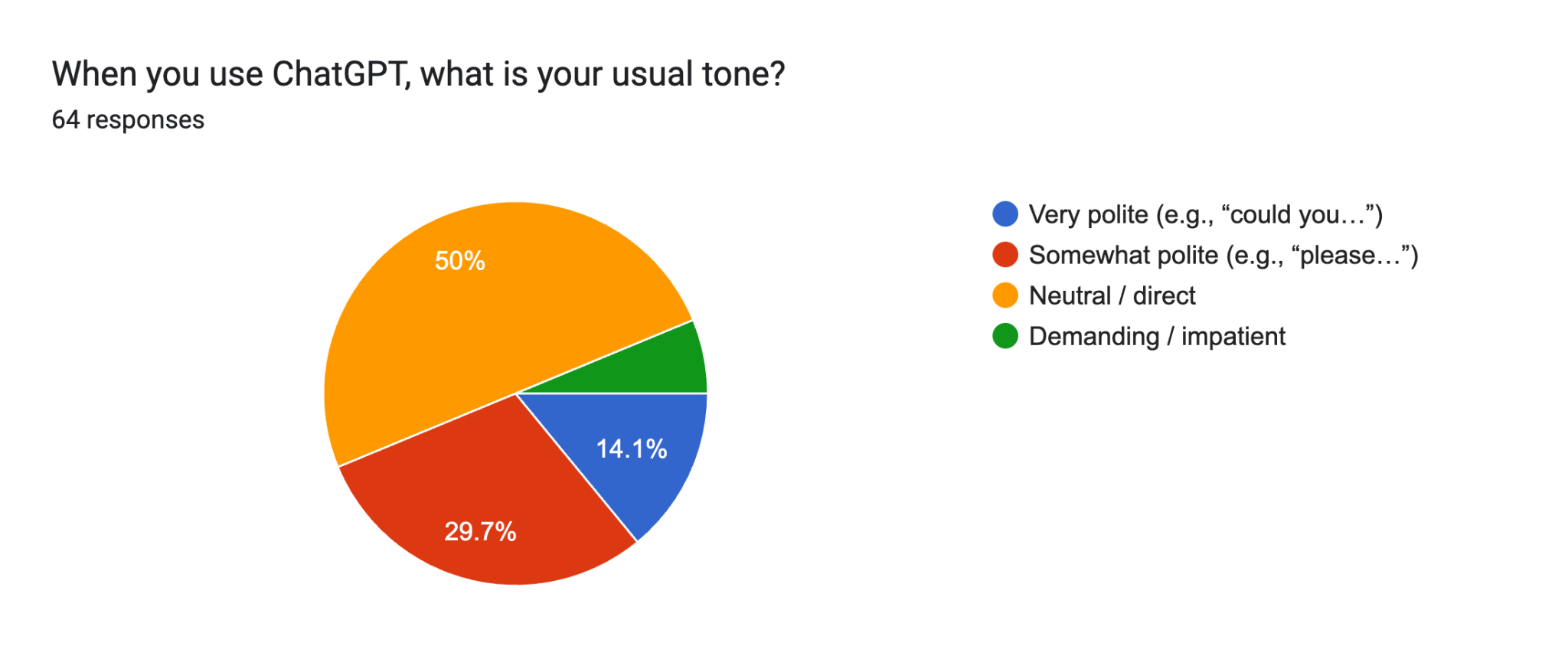
To test whether this instinct appears among students in my own community, I designed and issued a research survey to 188 classmates at The Storm King School. Of the 64 respondents, 50% reported using a neutral/direct tone in their interactions with ChatGPT, and 93.7% described their interactions as at least neutral rather than demanding. While this sample size is relatively small and not necessarily representative of the global population, these results suggest a general tendency toward politeness in interactions with ChatGPT, affirming Reeves and Nass' CASA thesis.
At the same time, excessive politeness can have diminishing returns. Evidence suggests that past a certain point, increasing politeness has no positive effect and may actually hinder the program (Yin et al.). For example, a prompt such as “Dear brilliant and wonderful assistant, I am so grateful for your wisdom, and I humbly ask if you might possibly help me” adds little to the task. From a technical standpoint, LLMs operate on "tokens," which are chunks of text that limit their processing. Overloading a prompt with excessive flattery or rambling courtesies wastes these tokens, diluting the core instruction and introducing unnecessary noise. A clearer version would be: “Please explain Fermi’s Paradox in three paragraphs for a high-school audience.” Therefore, if response quality is a primary concern of the user, the pragmatic goal is a baseline of clear, cooperative civility that does not veer into sycophancy.
My own research supports the idea that some users find ChatGPT’s responses to be less helpful when they communicate with overpoliteness. Of my respondents, 28.1% reported that they had changed their tone with ChatGPT. Of those, 41.7% reported that they had specifically changed their tone from polite to neutral because they found that polite responses tend to yield overly wordy, agreeable results as opposed to clear, concrete answers. Excessive politeness appears to yield less useful answers from ChatGPT, making it less advisable.
Another positive aspect of being polite to ChatGPT is the issue of habit formation and maintenance. Digital communication now dominates our daily lives. According to Gallup and Pew Research, text-based messaging is the most common form of communication among Americans under 50 (Gallup; Pew Research Center). Typing a message to a human friend and typing a prompt to ChatGPT are different acts, yet they often feel similar in habit. Because language evolved primarily for human communication, our brains struggle to separate the functions of "social courtesy" from "data transfer" when we type. As artificial intelligence becomes increasingly conversational, users may continue to form deep attachments to AI companions. In extreme cases, users have already attempted to "marry" their chatbots (The Guardian).
This phenomenon has been labeled the "Media Equation” by Stanford’s Reeves and Nass, who posit that humans naturally and unconsciously treat computers and digital media as real people. According to the Media Equation, our brains did not evolve to distinguish between "social" text from humans and "data" text from AI. Consequently, if we allow ourselves to form hostile, demanding habits when prompting ChatGPT, the brain may embed those habits, causing them to bleed into our human relationships. Psychologists Wendy Wood and David Neal describe habits as learned responses that become easier to repeat through recurring contexts (Wood and Neal). Over time, the way a person phrases requests can become a script reinforced through daily use. When users choose a polite and cooperative tone, they are not merely optimizing for the highest quality output, but also rehearsing habits of patience and restraint. When taking habit formation and maintenance into account, politeness towards ChatGPT may be helpful for maintaining social hygiene.
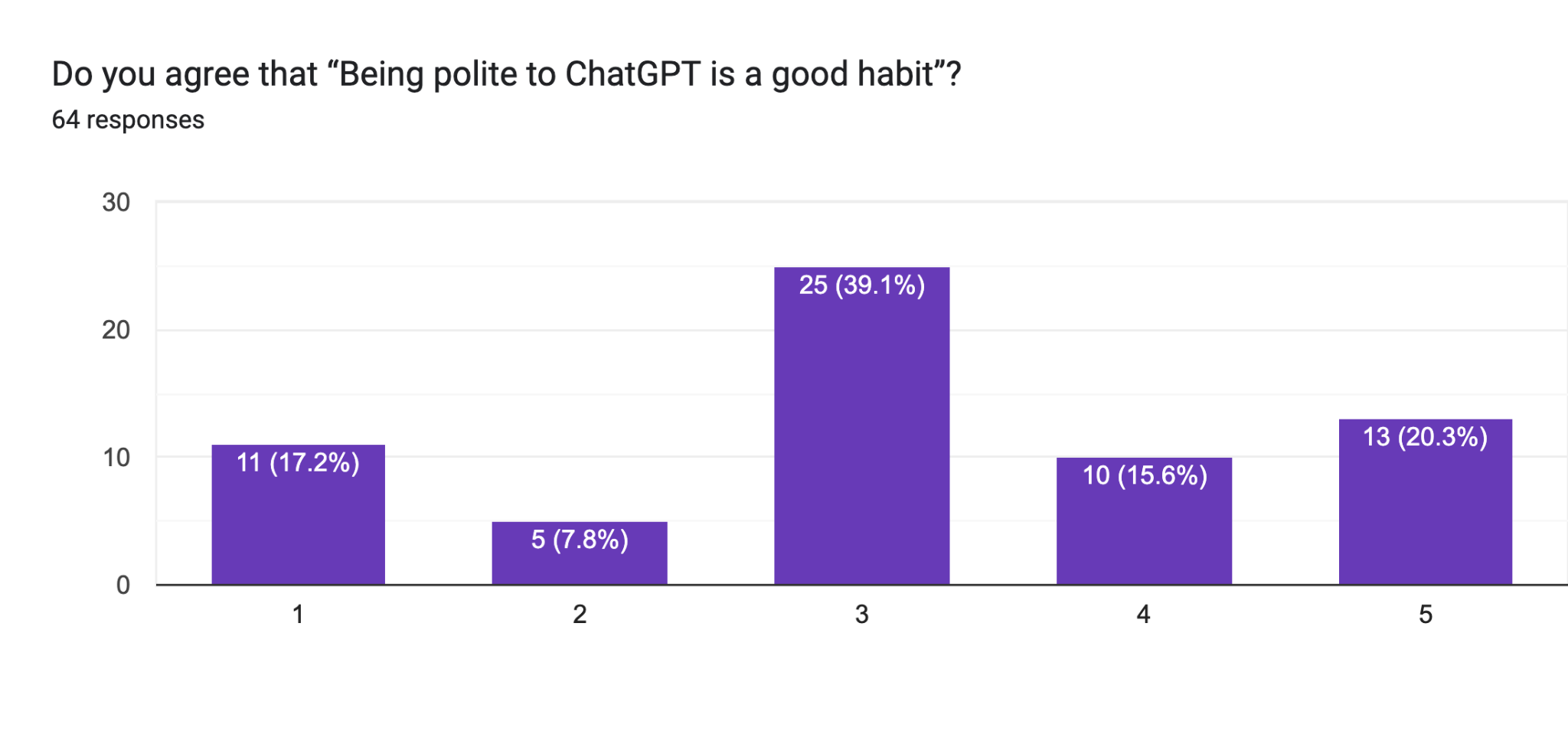
My independent survey supported the notion that users may be motivated to respond positively to ChatGPT out of habit formation and maintenance concerns. 75% of respondents responded in the 3-5 range (neutral to heavily agree) in response to: “Do you agree that 'Being polite to ChatGPT is a good habit?,” with 35.9% answering with either a 4 or 5 (agree to heavily agree). By contrast, just 25% of respondents answered in the negative (1 or 2). This seems to support the pro-social conclusion.
In addition to response optimization and habit formation and maintenance, the question of whether we should be polite to ChatGPT contains a longer-term, philosophical, and existential dimension: the trajectory of artificial general intelligence (AGI). The idea that AI might eventually take over humanity is a deeply ingrained societal anxiety, most powerfully and prominently expressed in apocalyptic pop-culture monoliths such as The Terminator's "Skynet" or the omnipotent machine-mind of The Matrix. While these examples are exaggerated, the underlying dread they express stems from a serious academic discourse, particularly with the rise of generative AI technologies like ChatGPT. Thought leaders like Oxford philosopher Nick Bostrom have written extensively on the "alignment problem," the immense challenge of ensuring that future superintelligent AI shares human values rather than seeking to dominate us (Bostrom).
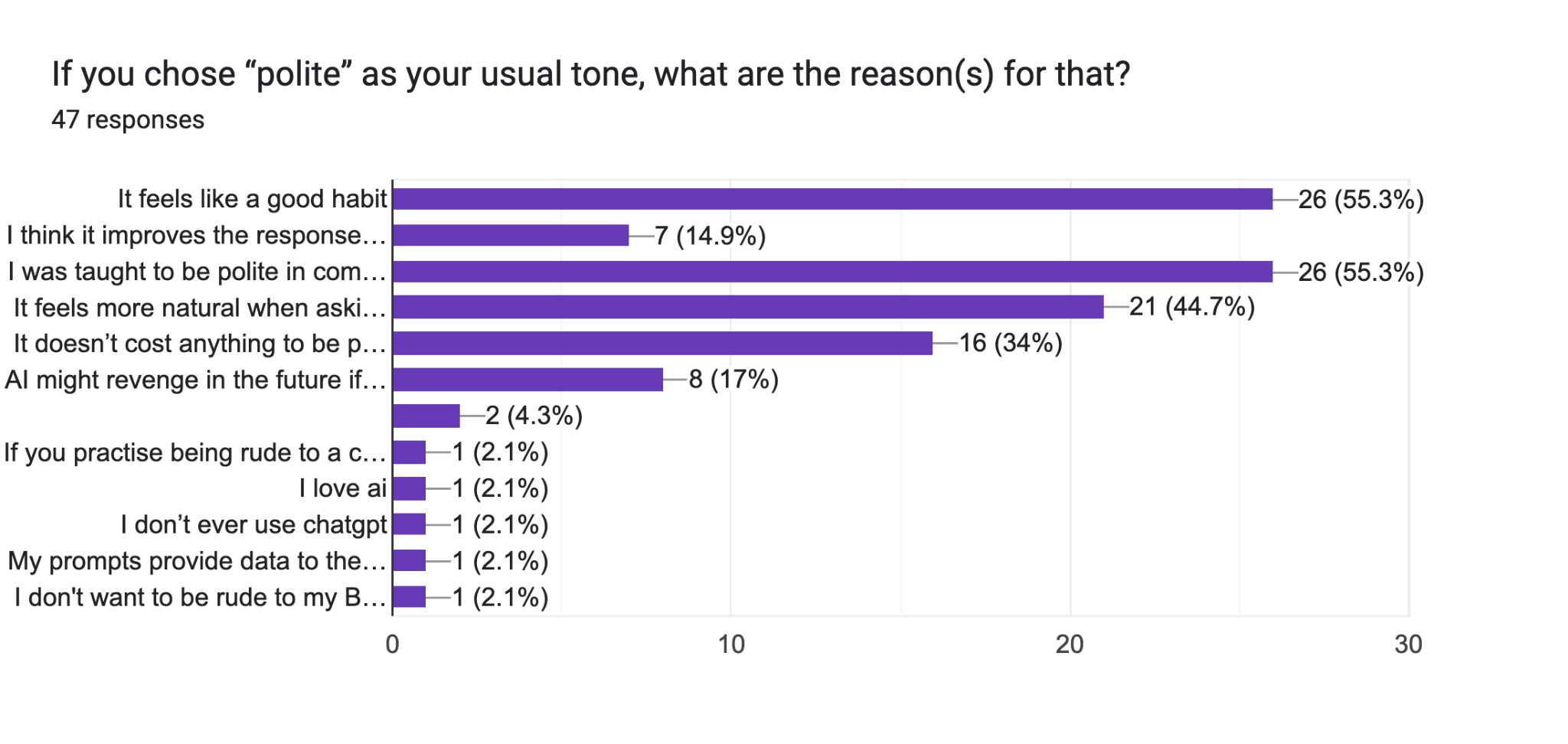
While being polite to a text generator might not directly prevent an AI uprising, it serves as a modern adaptation of Pascal’s Wager. Just as a common psychological driver for religious belief is the pragmatic "just in case" scenario (the idea that the everyday cost of believing in God is relatively low compared to the infinite penalty of being wrong), the same logic applies to our digital counterparts. "Just in case" AI rapidly evolves into a sentient autonomous superintelligence, establishing a foundational precedent of human-AI interaction based on mutual respect and cooperation would seem to be a logical safeguard. It may be in our best interest to present a flattering portrait so that we may be seen favorably if Judgment Day eventually arrives. Sure enough, a small but nonzero percentage of respondents (17%) reported as their reason for being polite to ChatGPT that “AI might take revenge in the future.”
There are, of course, exceptions to this user inclination. Because LLM architectures and training methods are constantly changing, the technical value of politeness may fluctuate across models and over time. OpenAI’s own prompting guidance, notes that newer models may respond better to shorter, outcome-first prompts than to long, process-heavy prompt stacks, which suggests that effective prompting is not a fixed etiquette rule but a moving technical practice (OpenAI, “Prompt Guidance”). In situations requiring extreme urgency, such as emergency translation, safety triage, or time-sensitive technical debugging, a user may be justified in removing conversational pleasantries and writing only the necessary instructions. The same logic applies financially, as prompting becomes more expensive as text input and output increase (OpenAI, “API Pricing”). Stripping away unnecessary courtesy in large-scale systems can be a reasonable design choice rather than a sign of rudeness (OpenAI, “What Are Tokens?”; “API Pricing”). These exceptions suggest that politeness to ChatGPT, due to prompt “noise” that could degrade output quality and increase expense at text increases, may indeed have its pitfalls.
Ultimately, the strongest recommendation is to balance engaging with ChatGPT in a civil tone while keeping the request precise and direct. Specificity often matters more than tone in determining the quality of a response, but maintaining a basic level of courtesy keeps the interaction stable. We should be polite to ChatGPT not because the machine necessarily deserves our respect, but because being polite may protect the quality of our data, and more importantly, both the integrity of our social habits and the reflection of our own humanity in the digital age.
References
- Austin, J. L. How to Do Things with Words. Clarendon Press, 1962.
- Bostrom, Nick. Superintelligence: Paths, Dangers, Strategies. Oxford University Press, 2014.
- Hájek, Alan. “Pascal’s Wager.” The Stanford Encyclopedia of Philosophy, edited by Edward N. Zalta, 1998.
- Heritage, Stuart. “‘I Felt Pure, Unconditional Love’: The People Who Marry Their AI Chatbots.” The Guardian, 12 July 2025.
- Newport, Frank. “The New Era of Communication Among Americans.” Gallup, 10 Nov. 2014.
- OpenAI. “API Pricing.” OpenAI, https://openai.com/api/pricing/. Accessed 16 May 2026.
- OpenAI. “Prompt Guidance.” OpenAI API Documentation, https://developers.openai.com/api/docs/guides/prompt-guidance. Accessed 16 May 2026.
- OpenAI. “What Are Tokens and How to Count Them?” OpenAI Help Center, https://help.openai.com/en/articles/4936856-what-are-tokens-and-how-to-count-them. Accessed 16 May 2026.
- Ouyang, Long, et al. “Training Language Models to Follow Instructions with Human Feedback.” Advances in Neural Information Processing Systems, vol. 35, 2022, pp. 27730–27744.
- Reeves, Byron, and Clifford Nass. The Media Equation: How People Treat Computers, Television, and New Media Like Real People and Places. Cambridge University Press, 1996.
- SETI Institute. “The Fermi Paradox.” SETI Institute, https://www.seti.org/research/seti-101/fermi-paradox/. Accessed 26 May 2026.
- Smith, Aaron. “Americans and Text Messaging.” Pew Research Center, 19 Sept. 2011.
- Wood, Wendy, and David T. Neal. “A New Look at Habits and the Habit-Goal Interface.” Psychological Review, vol. 114, no. 4, 2007, pp. 843–863.
- Yin, Ziqi, et al. “Should We Respect LLMs? A Cross-Lingual Study on the Influence of Prompt Politeness on LLM Performance.” Proceedings of the Second Workshop on Social Influence in Conversations (SICon 2024), Association for Computational Linguistics, 2024, pp. 9–35.