First-author research ·
Occupancy forecasting for building energy management
I investigated how forecasts of empty building periods could inform planning for heating, cooling, and lighting. The study connects model comparison with a practical question: when do a model's recommendations agree with recorded occupancy?
Manuscript submitted to ACM BuildSys; decision pending. Status reported by Junyu Chen on October 30, 2026.
My role
I developed the research question, prepared the data, built and compared the forecasting models, evaluated the results, and wrote the paper, with guidance from Prof. Chong Li.
The research question
Building energy planning needs more than a prediction for a single moment. It needs to identify continuous periods when a space may remain empty and understand how often those recommendations conflict with occupancy records. I studied that connection using the cleaned LBNL Building 59 dataset.
From data to decisions
Prepare and interpret the data
Organized the selected building streams into 15-minute observations and examined occupancy labels, time conventions, feature availability, and chronological data splits.
Build and compare models
Compared historical schedules, LightGBM, a compact Transformer encoder, a direct linear baseline, and hybrid forecasts that combine different modeling approaches.
Select with validation data
Selected a blend of historical, LightGBM, and Transformer scores. A separate threshold search selected recommendations lasting at least one hour, using an observed validation conflict cutoff.
Evaluate and explain the results
Assessed held-out forecast quality, recommendation errors, uncertainty, and selection stability. Made the Python analysis, saved outputs, tests, and paper available for inspection.
What the offline evaluation found
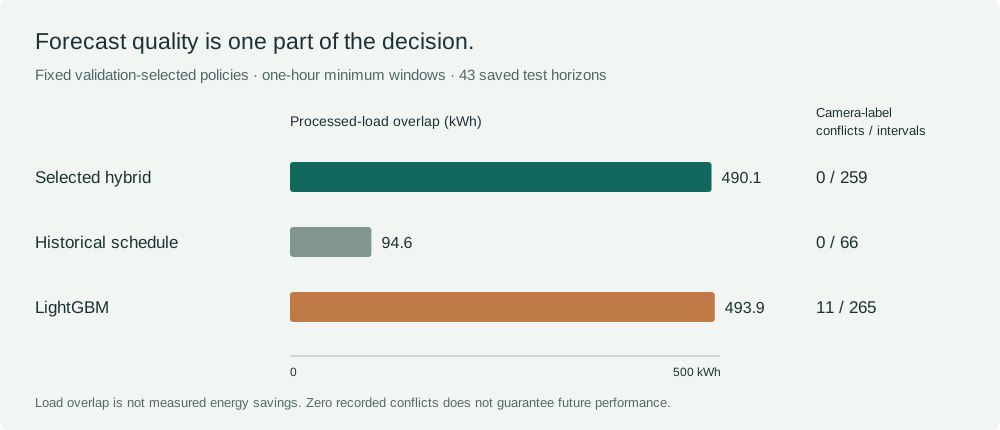
The fixed hybrid recommendation rule was evaluated across 43 non-overlapping test horizons. Its recommendations formed 14 sustained windows; all 259 recommended intervals matched the selected camera labels for empty space.
These counts describe the saved test period. Camera labels are the evaluation reference; zero observed conflicts does not guarantee future performance or establish physical absence.
Forecast comparison
Across 388,032 overlapping held-out forecast rows from 4,042 anchors, the hybrid achieved an Empty-class AUPRC of 0.8514. AUPRC summarizes how well scores distinguish empty periods across thresholds.
| Model | Empty AUPRC |
|---|---|
| Historical schedule | 0.8497 |
| LightGBM | 0.8382 |
| Compact Transformer encoder | 0.7621 |
| Direct linear occupancy baseline | 0.5933 |
| Selected hybrid | 0.8514 |
The hybrid's point-estimate advantage is small, and paired uncertainty intervals cross zero. These results do not establish statistically decisive superiority.
What this contributes
The study provides a model comparison and a reproducible way to assess empty-period recommendations alongside forecast accuracy. It makes the link between a prediction and its consequences explicit: which periods are recommended, which conflict with recorded occupancy, and what building load overlaps them.
The findings come from saved model outputs for one building. Testing forecasts with verified source timestamps and measuring changes in energy use require further evaluation. The study has not measured energy savings from a building intervention.
Explore the work
- Paper (PDF)
The full research argument, methods, and findings. The formal title is Validation-Selected Hybrid Occupancy Forecasting for Empty-Window Recommendations: An Offline Post-Bin Case Study.
- Code & results on GitHub
Modeling code, analysis scripts, saved predictions, result tables, figures, and tests.
- Reproduce the saved-output analysis
Instructions for regenerating downstream results from the committed prediction files, with a separate plan for empirical retraining.
Technical details and manuscript information
Evaluation scope and remaining empirical checks
This is a single-building, offline post-bin analysis of saved outputs. A stored anchor t covers the completed input bin [t, t + 15 min), so the effective availability boundary is t + 15 min. Original source timestamps and upstream imputation lineage remain unresolved.
- The forecast comparison uses 388,032 overlapping rows. Recommendation accounting uses 43 non-overlapping horizons. These are distinct evaluation units.
- The stored outputs are uncalibrated Empty-class scores. The 10% empirical validation conflict cutoff is a selection rule, not a future-risk guarantee.
- The 490.1 kWh figure in the paper is processed HVAC-plus-lighting load overlapping camera-label-empty recommendations, not measured savings or controllable capacity.
- Deep-model construction preceded seed reset in the saved runs. Empirical retraining must correct initialization, verify source timing, lock the environment, and evaluate on a later untouched period or an independent building.
- The legacy model identifiers "Original Transformer" and "DLinear" refer here to a compact Transformer encoder and a direct linear occupancy baseline, respectively.
Technical abstract
Building operations need occupancy forecasts that arrive in time, last long enough, and rarely conflict with later occupancy observations. We study this problem in a single-building, 15-min, offline post-bin case study. The primary hybrid is a weighted average of Empty-class scores from a historical schedule, LightGBM, and a compact Transformer, combining recurring, nonlinear, and sequential patterns. Validation area under the precision–recall curve (AUPRC) selects the weights. AUPRC summarizes Empty-class precision and recall across score thresholds; higher values indicate better discrimination when class frequencies are unequal. A separate validation search selects the operating threshold that maximizes a load-opportunity proxy under a 10% conflict-rate limit and a one-hour minimum window. Conflict rate is the share of recommended intervals later labelled occupied. The opportunity proxy sums processed HVAC-plus-lighting load in recommendations later labelled Empty and represents load available for further operational investigation. A stored anchor t covers the completed input bin [t, t + 15 min), making the forecast available at t + 15 min. Across 388,032 overlapping held-out forecast rows, hybrid AUPRC is 0.8514, compared with 0.8497 for the historical baseline and 0.8382 for LightGBM. Across 43 non-overlapping policy horizons, the fixed hybrid policy recommends 259 intervals; all are subsequently camera-label-empty, form 14 label-safe windows, and coincide with 490.1 kWh of processed load proxy. LightGBM finds a similar opportunity (493.9 kWh) with 11 conflicts, whereas the conflict-free historical policy finds 94.6 kWh. The hybrid therefore preserves strong forecast discrimination while improving the observed opportunity–conflict trade-off. A prospective rerun with verified source timestamps is the next step toward operational evaluation.
Manuscript status, citation, and archive
Validation-Selected Hybrid Occupancy Forecasting for Empty-Window Recommendations: An Offline Post-Bin Case Study
Junyu Chen and Chong Li, 2026. Unpublished author manuscript, submitted to ACM BuildSys with a decision pending (author-reported October 30, 2026). The supplied PDF is preserved unchanged; its final declaration and persistent-archive fields remain to be completed. The research roles described on this page were confirmed by Junyu Chen.
Download citation (BibTeX) · Manuscript provenance · Archived research snapshot
Forecast metrics (CSV) · Recommendation results (CSV) · Repository audit